The ranking predicts nothing
August 2026 · Backtesting · multiple comparisons
QuantDesk sorts a universe of stocks by a seven-signal composite. I finally measured whether that order predicts anything. It does not — and the app now says so on the panel that produces it.
A composite that sorts a universe makes a claim without ever writing it down. Put twenty names in an order and the order implies it means something — that the top of the list is a better place to look than the bottom. Nothing in QuantDesk had ever checked whether that was true.
This was an inconsistency, not an oversight I can excuse. The flow lens has been held to a stricter standard since the day its event study shipped: it measures whether an anomaly flag actually precedes abnormal returns, and it reports the null when there is one. The breadth tier was asserting its usefulness by omission while the lens beside it was doing the work.
What the test was
Twelve backtests: four universes at three holding periods. Each ranks its universe using only data that existed on the ranking date, then measures the rank correlation between that order and what actually happened next. Six years of history.
The constraint that matters is the first one. A ranking built with any data from after the ranking date will look predictive, and the amount by which it looks predictive is a measure of the leak rather than of the signal.
The answer
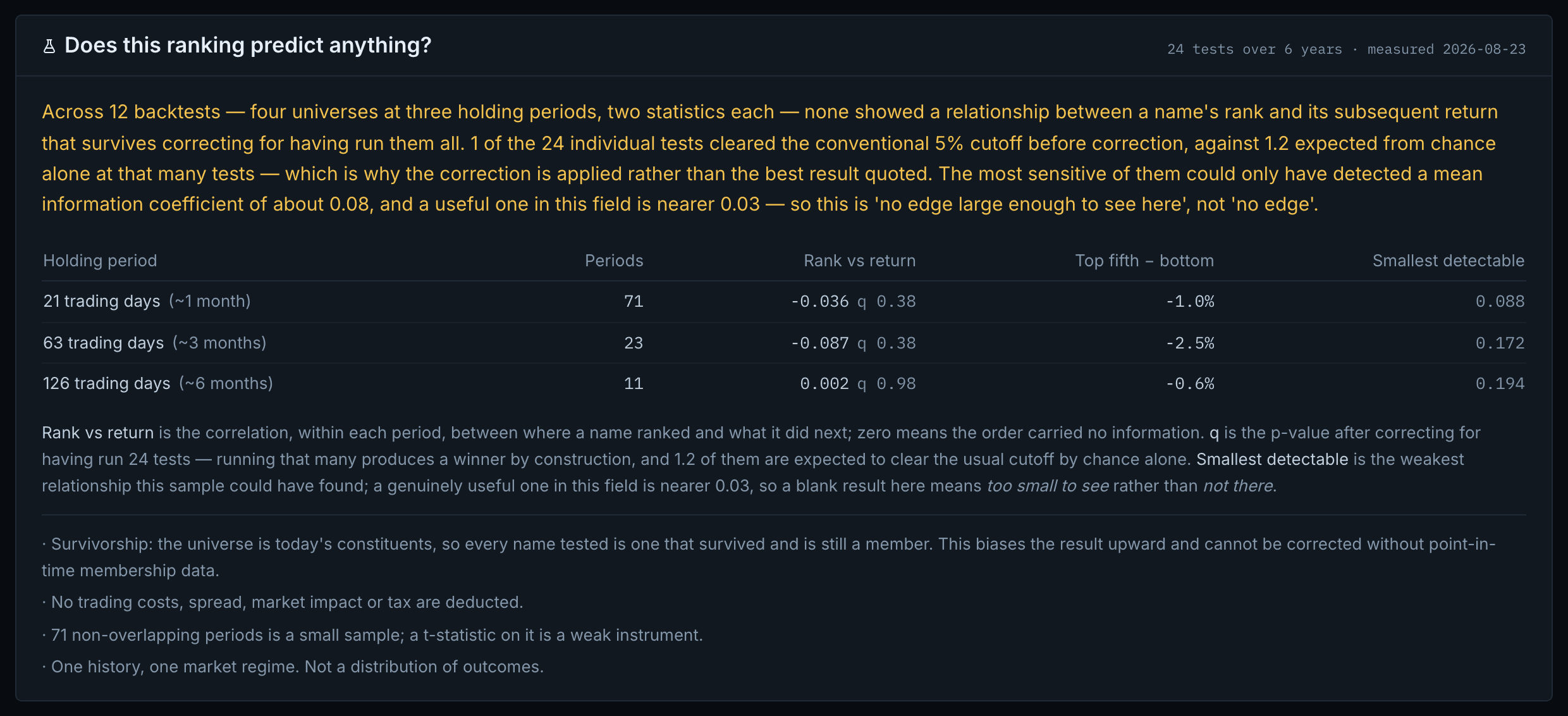
Twenty-four tests. One of them cleared the conventional 5% cutoff.
At twenty-four tests, 1.2 are expected to clear it by chance. So the honest reading of "one significant result" is that I found slightly fewer than the number I would expect from noise. None of the twenty-four survives a Benjamini–Hochberg correction.
The panel also reports what the test could have detected. With 71 non-overlapping periods, the most sensitive horizon could only have found a mean information coefficient of about 0.08; a genuinely useful one in this field is nearer 0.03. That distinction matters more than the p-values: this is "no edge large enough to see here", not "no edge".
Aside
why the correction is not optional
Running many tests produces a winner by construction. Reporting that winner without the correction is not a small statistical impropriety; it is the entire finding. QuantDesk's anomaly screener already applies Benjamini–Hochberg to its own hits for exactly this reason, so declining to apply it here would have meant holding two parts of the same app to different standards.
What shipped
The panel that presents the ranking now states, in the product, that these seven signals did not predict returns over six years of testing. It still ranks. The ranking is still useful as a way to narrow a universe to a shortlist worth opening the slower lenses on — that is what the breadth tier is for.
What it no longer does is let its own layout imply a claim it cannot support. An ordered list looks like a prediction whether or not you intended one, so the correction had to be stated where the list is, not filed somewhere a reader would have to go looking.
What this does not establish
That these signals are worthless. A null over four universes and three holding periods is a null in this test, on this data, at this horizon — not a proof of absence. A different universe, a longer hold, or a conditioning variable I did not try could all produce a different answer.
It also says nothing about the other three lenses, which read different data and are measured separately. The result is narrow on purpose. A negative result stated more broadly than it was tested is the same failure as a positive one.
The panel described here is in QuantDesk, which is live and whose source is public.